Case study > Mobile > Development of a Mobile App with Geolocation and Gamification for Lubelscy Kupcy

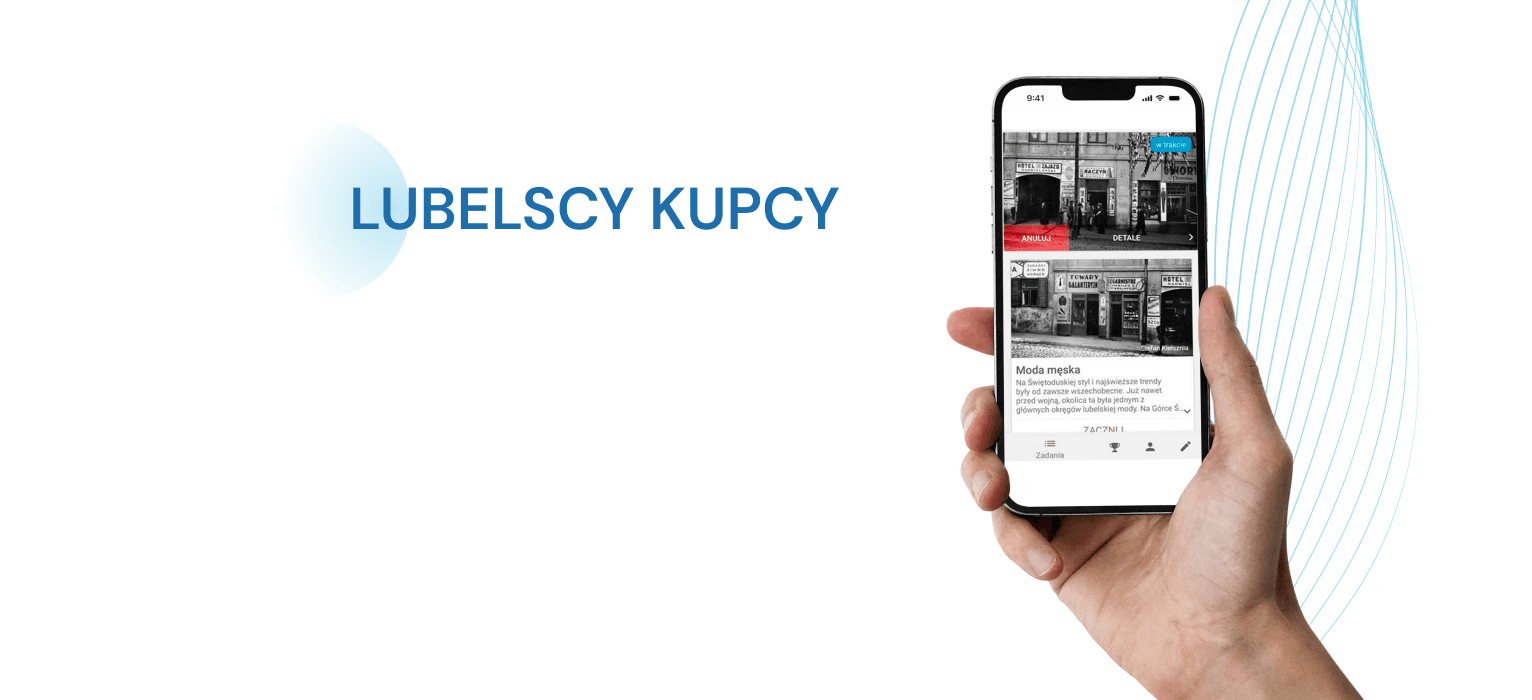
Edge One Solutions supported Lubelscy Kupcy by providing IT expertise responsible for developing a mobile solution supporting digital transformation and improving communication between businesses and their customers.
The project included creating a mobile application designed to provide convenient access to information and services, developing user-oriented functionalities, and delivering a scalable solution adapted to the needs of local commerce.
The goal of the project was to create an application that encourages users to explore the city through physical activity and interaction with its history. The application needed to combine education with entertainment in an accessible and engaging format, so that users would not only read about the history of Lublin but experience it in specific locations across the city.
A key challenge was to use the map and the user’s location to guide them through places connected with the history of local merchants and the city’s former commercial structure. These included locations such as former hairdressing salons, textile shops, and historic shopping arcades.
Another important challenge was maintaining user engagement. Historical content alone might not be enough to keep users motivated, so the application needed to include points, competition, ranking, and gamification mechanisms that encourage users to complete the route.

Edge One Solutions supported the development of a mobile application combining city game mechanics, geolocation, and historical education.
The scope of work included:
• development of a mobile application based on user location,
• use of a map to guide users along a historical route,
• implementation of tasks assigned to specific points on the map,
• activation of tasks after the user reaches the correct location,
• implementation of a points system,
• development of a participant ranking mechanism,
• use of time and location as elements of task evaluation,
• implementation of hints and historical descriptions,
• combining educational content with a light entertainment format,
• use of Android SDK, Google Maps API, Gamification Engine, and Firebase.

The Edge One Solutions team created a mobile application that guides users through a historical route and engages them in completing field tasks. Users can log in, select a route, and follow the hints provided by the application.
Tasks are assigned to specific points on the map and are activated when the user reaches the correct location. As a result, the application is not a static guide, but an interactive city game in which urban space becomes part of the user experience.
The solution includes a participant ranking showing points and user progress. The evaluation system takes into account both the time and location of task completion — the faster and more accurately the user completes a task, the more points they can earn.
The application also includes hints and descriptions that present local history, architectural style, and the former functions of selected buildings in an accessible way. This allows users to gain knowledge in a natural context — while walking through the city and interacting with real locations.

City applications based on geolocation can effectively combine education, tourism, and physical activity. Instead of presenting history only as text, they can guide users through real places, activate tasks in specific locations, and build engagement through gamification mechanisms.
For public institutions, museums, tourism organizations, and cities, this format can be a modern way to tell local stories. A mobile application becomes not only a guide, but an interactive educational tool that engages users in the space where the story actually took place.
The Lubelscy Kupcy project shows how mobile technologies, maps, geolocation, and gamification can support the promotion of local heritage and create more engaging experiences for residents, tourists, and participants in educational initiatives.